Manny Anderson
A Killer’s MindManny Anderson is the young man wrongly blamed for the 1997 Maynard murders, a mistaken accusation that ends in his death and leaves the actual killer, Rod Glover, free. His story shows how thin clues, a shifting timeline, and a town’s desire for a culprit could harden into a case against an innocent person. Years later, the investigation revisits the evidence and exposes how an altered estimate of Clara Smith’s time of death helped give Glover an alibi.
Identity and Early Suspicion
Manny Anderson was a high-school senior who often sat alone in the town library reading. Zoe Bentley had seen him there while researching the murders. To the police, however, his quietness and lack of close friendships became part of a suspect profile rather than ordinary details of a young man’s life. A teacher also reported that he drew unusual cartoons in his notebooks and played Dungeons and Dragons with friends. None of those details established that he had committed a crime, but investigators treated them as pieces that seemed to fit once suspicion had settled on him.
The allegations linking Manny Anderson to the victims were circumstantial. He was said to have followed Beth Hartley, and a student reported hearing that he had once asked Clara Smith out. The police also believed that the killer used gray ties belonging to Manny Anderson’s father, who wore them to work. Since gray ties had been used in the murders, the family connection offered investigators a tangible-seeming explanation for a recurring detail. But it did not establish that Manny Anderson had taken or used those ties, and it did not resolve the conflicts in the case chronology.
Arrest and Public Blame
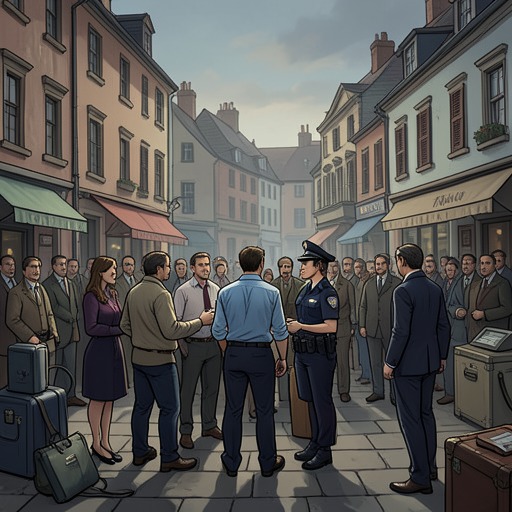
The police arrested Manny Anderson on suspicion of the murders after finding a photograph of Beth Hartley in his home and what they characterized as other suggestive evidence. The supplied account does not specify what that additional evidence was. His innocence was maintained by his parents, while local newspapers placed his face alongside portraits of the three young women who had been killed. The contrast between the public certainty of the accusation and the limited, ambiguous facts behind it became central to Zoe Bentley’s sense that the case had gone wrong.
The accusation also displaced Zoe’s warning about Rod Glover. She believed Glover was the killer, but the police had an apparent reason to dismiss her: Glover was recorded among the people who joined a search party after Clara Smith disappeared. One investigator told Zoe that seventy-eight people, including him, had been with Glover during the time of death, and treated that as an alibi. The crowd’s presence seemed to settle the question of Glover’s opportunity, while suspicion of Manny Anderson gained force from his associations and manner.
The Timeline That Convicted Him
Years later, Tatum Gray examined how the official timeline had been established. Dr. Foster had initially placed Clara Smith’s death around noon, perhaps as late as two in the afternoon. That estimate was difficult to reconcile with Manny Anderson’s presence in the library between one and four. Dr. Foster changed her assessment two days later, placing the death between six and seven in the evening. The new interval allowed the case against Manny Anderson to proceed, even though the adjustment also made Glover’s participation in the search party look like an alibi.
In questioning Dr. Foster, Tatum Gray argued that fear had shaped the inquiry: once Manny Anderson became the suspect, the pressure to make the evidence support that theory grew. He suggested that Nathan Price had challenged the original estimate, and that the revision may have followed either pressure to dismiss the initial time or a search for a period when Manny Anderson lacked an alibi. Dr. Foster cited the difficulty of estimating time of death in cold conditions, but acknowledged that she had changed her estimate. Tatum’s reconstruction makes the altered timing more than a technical discrepancy: it links the wrongful accusation to the apparent exoneration of the actual killer.
Death and Reassessment
Manny Anderson died in his cell after hanging himself with a bedsheet. The police treated his death as the end of the case: the suspected killer was gone, and residents could feel safe again. For Zoe Bentley, the conclusion brought grief for Manny Anderson as well as for herself. His death removed the possibility of proving his innocence in court, while Glover escaped the suspicion Zoe had tried to direct toward him. She believed that if she had been older or had possessed more authority, Glover might have been jailed and Manny Anderson might still have been alive.
Later, Tatum Gray stated plainly that Manny Anderson had never killed anyone. The revelations about the revised time of death recast the earlier evidence: the library interval had been inconsistent with the initial estimate, and the later estimate placed Clara Smith’s death during the search party that supplied Glover’s apparent alibi. Manny Anderson’s arrest and death therefore did not resolve the murders; they helped close public attention around the wrong suspect. His fate remains a measure of the cost of treating social suspicion as proof, and of allowing a desired conclusion to determine how uncertain evidence is read.
Narrative Role
Manny Anderson’s role extends beyond that of a wrongly accused suspect. His case binds Zoe Bentley’s early failure to expose Glover to the later investigation that reopens the Maynard murders. At first, Manny Anderson’s solitary habits, reported attention to Beth Hartley, and supposed access to gray ties seem to offer a coherent explanation. Reconsidered alongside the library record, the disputed medical estimate, and the search party, those details instead reveal how an accusation can gather apparent support without accounting for the full sequence of events.
The tragedy is also carried forward through the consequences for his family. Manny Anderson was his parents’ only son; after his death, they spent years trying to prove his innocence. The case thus leaves a double legacy: the real killer remained beyond the law, while the family of the man blamed for the crimes had to continue contesting a conclusion that the authorities had treated as settled. Manny Anderson’s eventual exoneration in Tatum Gray’s account comes too late to restore either his life or the chance for his innocence to be established while he could answer the charge.